Posts

Showing posts with the label writing

Benhabib Clarifies Arendt, and the FYW Course Engaged in Practical Discourse

Previous post on Hannah Arendt and action = promise + forgiveness If I accept Arendt's proposition that action requires promise and forgiveness in an ideal public, or even to nurture a nascent public, then I also need to define that public as an associative one, not an agonistic one, such as our current social constitution today. Seyla Benhabib explains this where he argues that Arendt's vision of public is a liberal one, in the Kantian sense, such that liberalism is a culture where the question of legitimacy is paramount and necessarily consistent. Calling upon Ackerman “Whenever anybody questions the legitimacy of another’s power, the power holder must respond not by suppressing the questioner but by giving a reason that explains why he is more entitled to the resource than the questioner is” [Ackerman 14]. Ackerman understands liberalism as a way of talking about power, as a political culture of public dialogue based on certain kinds of conversational constraints. The m...

We Will All Become Barbarians

Image
I presume that we would not want to be overcome by barbarians -- from without, or from within. I learned the etymology of "barbarian" when I was just a boy, when I was interested in the meaning of my family's names, when I searched the origin of my aunt Barbara's name. barbarian (adj.)   mid-14c., from Medieval Latin  barbarinus  (source of Old French  barbarin  "Berber, pagan, Saracen, barbarian"), from Latin  barbaria  "foreign country," from Greek  barbaros "foreign, strange, ignorant," from PIE root  *barbar-  echoic of unintelligible speech of foreigners (compare Sanskrit  barbara-  "stammering," also "non-Aryan," Latin  balbus "stammering," Czech  blblati  "to stammer"). Greek  barbaroi  (n.) meant "all that are not Greek," but especially the Medes and Persians. Originally not entirely pejorative, its sense darkened after the Persian wars. The Romans (technically themselves...

Pygmalion or Golem? -- Writing Students and Self-Efficacy

Image
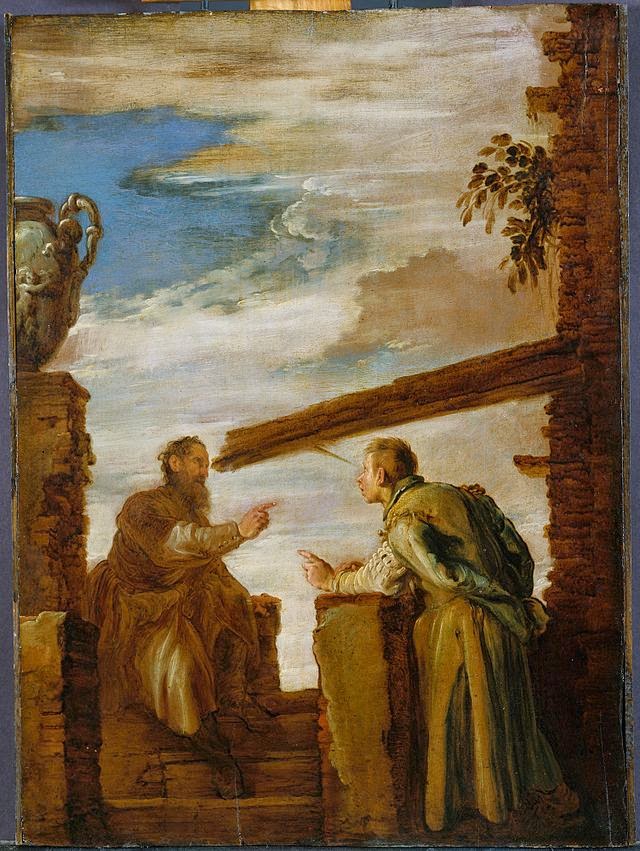
The Parable of the Mote and Beam, Domenico Fetti, ~1619, (c) Metropolitan Museum of Art Sinned Against and Sinning I feel that somewhere, sometime, we've all sinned. We've all sinned in criticizing, mocking, deriding students' work. It's a mote-beam, problem, really, as we forget where we come from, where our writing was when we were first year students. Many of us in the teaching professions also come from different economic and literacy backgrounds that can't compare to those of our students today. This is certainly true for many students who attend community colleges such as mine, many coming from lower SES environments, struggling schools, homes with few literacy experiences other than those of mass media and family lore. I don't devalue these last two discourse environments, but too seldom are these discourses are undervalued in the first year course, many instructors adamant that the course is designed to inculcate those middle class values (Bloom) o...

Peckham: Argument, the Working Class, and Latino Working Class Students (Pt 2)

Image
[ Part 1  where I introduce Peckham's discussion of argument and middle class "objectivity"] Di. "Spew" 10 October 2013. Flickr Creative Commons Objectivity, Redux  Peckham continues with the discussion of objectified pronouns, with the first person "I" largely permitted in most courses, though even there the first person must be objectified, "the writer in possession of her reason, language and stance" (69). Working-/ poverty-class students resist using the first person "I" in writing even in ethnographic or public discourse writing because of their secondary education training, even when it makes rhetorical sense with the project at hand. On the other hand, they tend to use the second person easily, naturally, as if somehow the first person has been drummed out of them but instruction about second person pronouns was overlooked. Something is happening, then, in secondary education about that author-as-expert vs author-as...

Peckham: Argument, the Working Class, and Latino Working Class Students (Pt 1)

Image
Creative Commons Peckham, Irvin. "Arguing." Going North, Thinking West: The Intersections of Social Class, Critical Thinking, and Politicized Writing Instruction . Logan UT: USUP, 2010: 67-85. Print. FYW's distinction is to see one's writing from the other's eyes. This goes back to Flower and Hayes and earlier -- the need for the author to write beyond himself, expecting a reader to experience and interpret.  As cognitive psychology progressed in the late 1970s, more specific applications of the social science were proposed for the composition course. In 1977, Carnegie-Mellon English professor Linda Flower directly proposed the use of problem-solving strategies in composition (Flower and Hayes, “Problem-Solving Strategies” 450-452). [Flower and her psychologist colleague John Hayes believed that heuristics open complex communication processes to the possibility of rational choice. These problem-solving strategies could help the struggling writer put idea...

Resistance In/Of the Classroom

Image
Referencing the Egyptian Revolution, by artist Graphic Resistance, 2011 <http://graphic-resistance.deviantart.com/> Plenty of research has been published on resistance of/by students within the classroom, especially within the writing classroom. A brief, incomplete, bibliography: Carter, Christopher. Rhetoric and resistance in the corporate academy. Hampton Pr, 2008.  Corkery, Caleb. "Rhetoric of Race: Critical Pedagogy without Resistance." Teaching English in the Two-Year College 36.3 (2009): 244-256.  Flowerdew, John. "13 Critical discourse analysis and strategies of resistance." Advances in discourse studies (2008): 195.  Gorzelsky, Gwen. "Working boundaries: From student resistance to student agency." College Composition and Communication (2009): 64-84.  Palmerino, Gregory. "Opinion: Teaching Bartleby to Write--Passive Resistance and Technology's Place in the Composition Classroom." College English 73.3 (2011): 283-302...

On Writing and Writing about Writing

I was asked to read ... a text  this week. It was flat, bland, uninspiring, safe. The text attempted to reach an audience that doesn't exist, using signs that lead to nowhere. It was safe. It was academic-ish. It would offend no one, nor inspire anyone. I gave some feedback -- safe, uninspired, uninterested because the text is uninteresting. That's the way it is sometimes ... texts passing in the night as uninteresting, unengaging, as the Palace Guards -- form, and some purpose, but largely immaterial to one's real life. Then I sat with a student today and he shared a paragraph response to the Students' Right to Their Own  Language  statement, which I have all students read at the beginning of the semester. Actually, only the first 8 pages for the first week, and that discussion keeps us busy for several weeks later. It's a difficult text for first year students, but with only a few days in the course, this student comes up with this in his writing journal: 29...

LSC - NH Write Club Fall 2014

Dozens of students in Spring 2014 found it helpful to find a safe place off campus and just write  and as needed, get feedback from peers about their writing. Most of this writing was academic, but not all. I'll continue to host Write Club in Fall 2014, with some significant changes: The night will change to Tuesday .  1. This is because the LSCS Board meetings are held once a month on Thursday and I want to permit all students, faculty, parents, taxpayers to attend the Board meetings. 2. I want to avoid Wednesday night when most people who attend church do so. I realize that some people attend church on Tuesdays, but I'm trying to accommodate as many as I can. 3. I've found that too many academic projects are due later in the week. Perhaps even one or two more days of revision will help. The place will change to Aldine , specifically (for now) Starbucks on I-45 and West Road, in front of Best Buy (I hate the product placements I just dropped, but those who are look...

Doubting the Rhetorical Situation

Image
First, this: Amnesty International - Pens from Troublemakers.tv on Vimeo . That message -- that somehow the act of writing changes the world. I'm not wholly convinced, yet, though I suppose my students and colleagues believe that's what I think. I do, fully, believe that writing changes us, changes our world, changes the way we see the world, changes the way we make the world. But there are other writers, writers in the dark. Writers with law degrees and political appointments and writers who are the result of a sperm and egg of powerful males and females before them. They write too. Or sometimes they only speak, and someone they own writes for them. So my writing is against their writing; my words against their words; my letters against their letters; my comma against their comma. The belief that writing changes the world for the better -- that a signature, for example, will somehow validate the democratic experiment -- is ultimately naive. My signature cannot move ...